Quick Answer: What To Do Right Now
Shut the water off, kill the power to the dishwasher circuit, pull standing water with towels, and pop the toe kick off to check the cavity underneath. If water reached cabinet bases or flooring seams, call a restoration company within 24 hours. Mold colonization starts between 24 and 48 hours on wet organic material.
First Five Minutes
- Close the dishwasher supply valve under the sink (quarter turn handle, perpendicular to the pipe means off)
- Switch off the breaker labeled for the dishwasher or kitchen circuit
- Open the dishwasher door and bail any standing water from the tub
- Pull towels or a wet vacuum across the floor to stop spread
- Photograph everything before you move appliances or wipe surfaces
First Two Hours
- Remove the toe kick panel at the base of the dishwasher
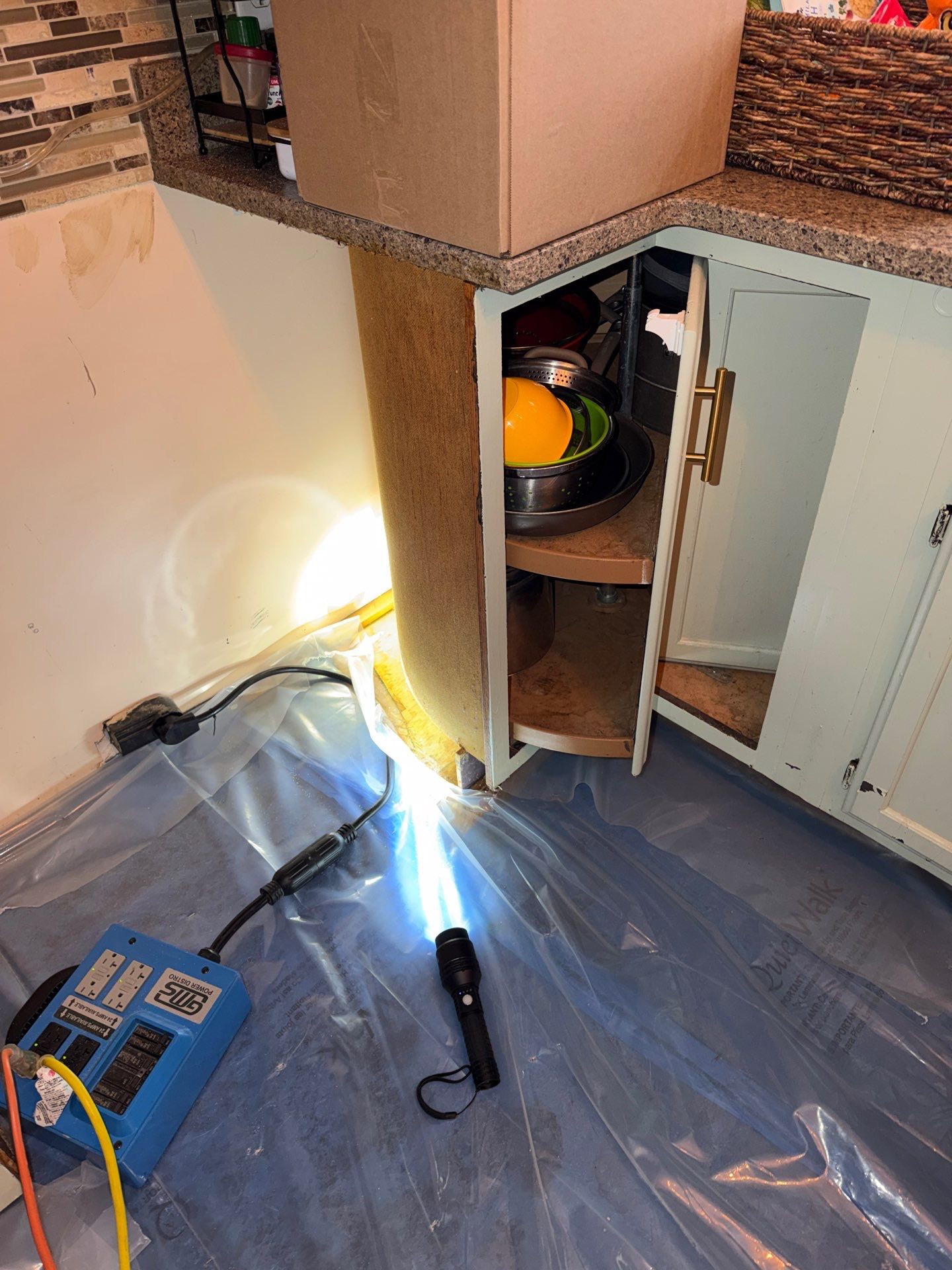
- Check the subfloor under the unit with a flashlight
- Pull the dishwasher forward if the supply lines allow slack
- Inspect adjacent cabinet floors and the sink base for migration
- Call for a moisture assessment if any wood feels soft or any laminate has lifted
What Not To Do
- Do not run the dishwasher again to "test" whether the leak stopped
- Do not use a household fan on saturated hardwood (it dries the surface and traps moisture below)
- Do not pull cabinet kick plates with a pry bar that can split the face frame
- Do not assume a dry looking floor means dry subfloor, the visible surface lies
Where Dishwasher Water Actually Goes
The leak you see is rarely the leak that matters. Water follows gravity and the path of least resistance, which in most Sweetser kitchens means it tracks along the subfloor seam toward the sink base or the exterior wall. Our kitchen appliance leak guide covers migration patterns in more detail.
| Leak Source | Typical Failure | Damage Pattern |
|---|---|---|
| Supply line | Braided hose cracks at the fitting | Constant slow drip behind the unit, soaked subfloor |
| Door gasket | Hardened rubber, food debris in seal | Front of unit puddles, warped flooring at the door swing |
| Drain hose | Loose clamp, kinked line, clog backup | Sudsy water in sink base, smell of detergent |
| Pump or motor seal | Bearing wear after 8 to 10 years | Pooling under the tub, intermittent puddles after cycles |
| Inlet valve | Solenoid stuck open | Overfilling, water spilling from vent and door |
In Sweetser homes built on a slab, water often runs sideways under the cabinet run and shows up two cabinets away from the dishwasher. In homes with a crawlspace, gravity wins, and the first sign is often a stain on the basement ceiling drywall or insulation that has dropped between the joists. Either way, the puddle you mop up is the smallest part of the problem.
Prevention That Actually Works
Annual Maintenance Checklist
- Replace braided supply lines every 5 years, no exceptions
- Inspect the door gasket for cracks and clean it monthly
- Run a dishwasher cleaner through an empty cycle quarterly
- Check the drain hose for kinks behind the unit
- Test the shutoff valve under the sink twice a year (they seize if never turned)
Hardware Upgrades Worth the Cost
- Stainless braided supply line with auto shutoff (around $40)
- Dishwasher drip pan with leak sensor ($25 to $60)
- Smart leak detector tied to a whole home shutoff valve ($200 to $600 installed)
- Quarter turn ball valve replacement for old gate valves
Habits That Prevent Half of All Calls
- Do not run the dishwasher when you leave the house
- Do not run it overnight
- Scrape plates so the drain pump does not strain
- Replace the unit at 10 years rather than the 12 to 15 most owners stretch it
Signs Your Dishwasher Is About to Fail
- Dishes still wet at the end of the heated dry cycle (heating element or vent gasket)
- Standing water in the tub between cycles (drain pump or check valve)
- Rust streaks on the lower rack or tub bottom
- Detergent residue around the door, indicating a gasket that no longer seals
- Cycle times that have crept noticeably longer over the last year
Any two of those signs together mean the unit is on borrowed time. Replacing a $600 dishwasher is always cheaper than replacing a $4,000 kitchen floor.
For homes where the flood spread beyond the kitchen, our water damage restoration service covers structural drying, content handling, and reconstruction under one roof. If the water sat long enough that you are noticing musty smells, review the 48 hour mold timeline before deciding to handle it yourself.
Damage Severity by Response Time
The faster you act, the less you replace. Here is how response time correlates with restoration scope on a typical dishwasher flood in a Sweetser kitchen.
Sweetser Water Restoration crews typically reach Sweetser addresses within 2 hours of the first call, which keeps most jobs in the first two cost tiers. The jump between the 24 hour and 48 hour windows is where homeowners lose the most money, because that is when cabinet bases start to swell and hardwood begins to cup past the point of sanding flat.
Materials At Risk
Almost Always Recoverable If Caught Early
- Drywall above 4 inches from floor
- Tile flooring with intact grout
- Painted cabinet exteriors
Recoverable With Professional Drying
- Engineered hardwood (depends on core layer saturation)
- MDF cabinet bases (only if dried within 24 hours)
- Carpet pad in adjacent rooms
Usually Replaced
- Particleboard subfloor that has swelled
- Solid hardwood that has cupped and crowned
- Laminate flooring once edges have peaked